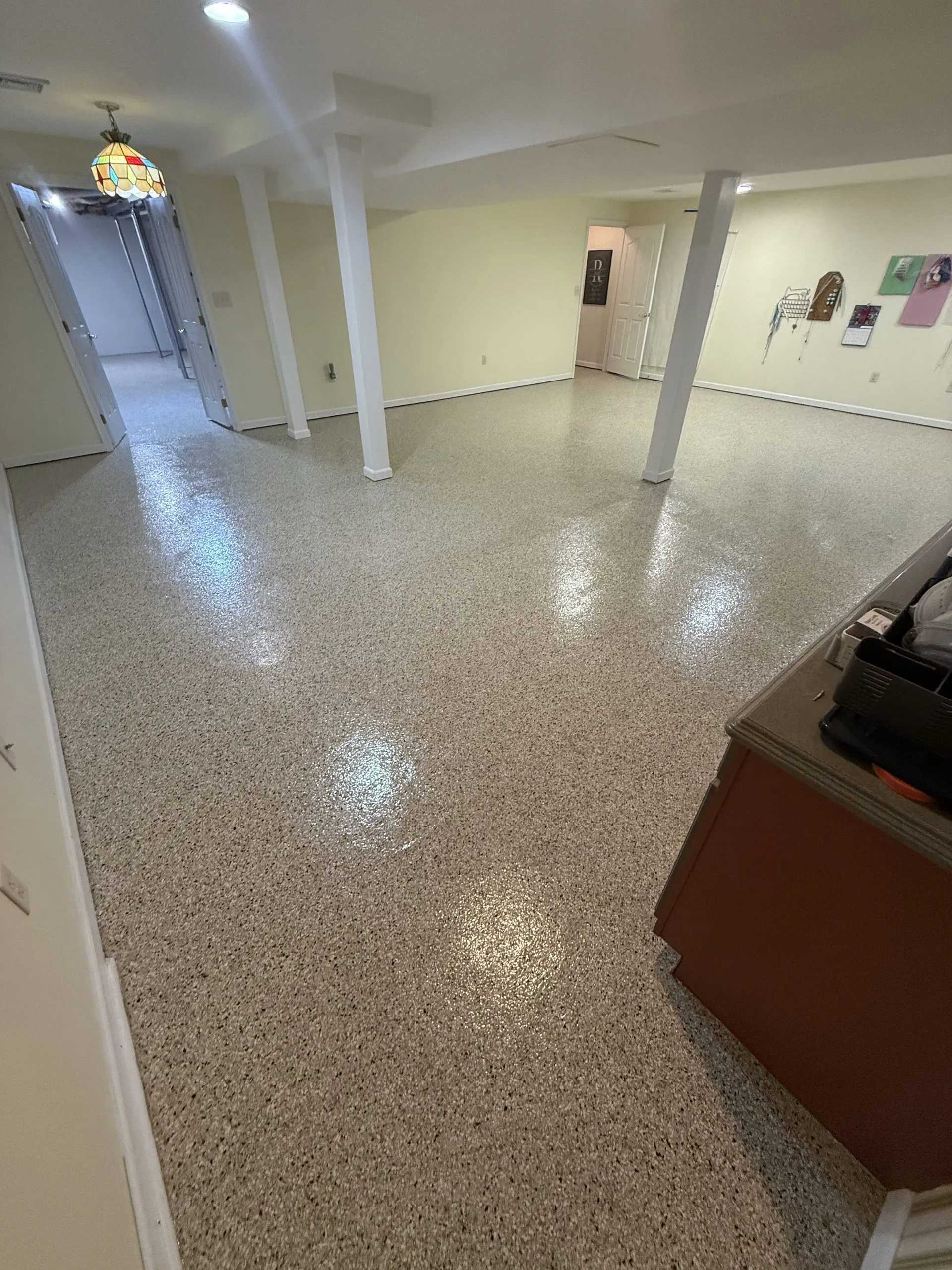
The same basement room photographed at four stages: the bare stained slab, the diamond grinder mid-pass, the open profiled concrete after grinding, and the finished coated floor. It is the clearest illustration we have of why preparation is the part of the job that decides whether a floor lasts. This is a finish study of a real floor we photographed, not a record of a specific job.
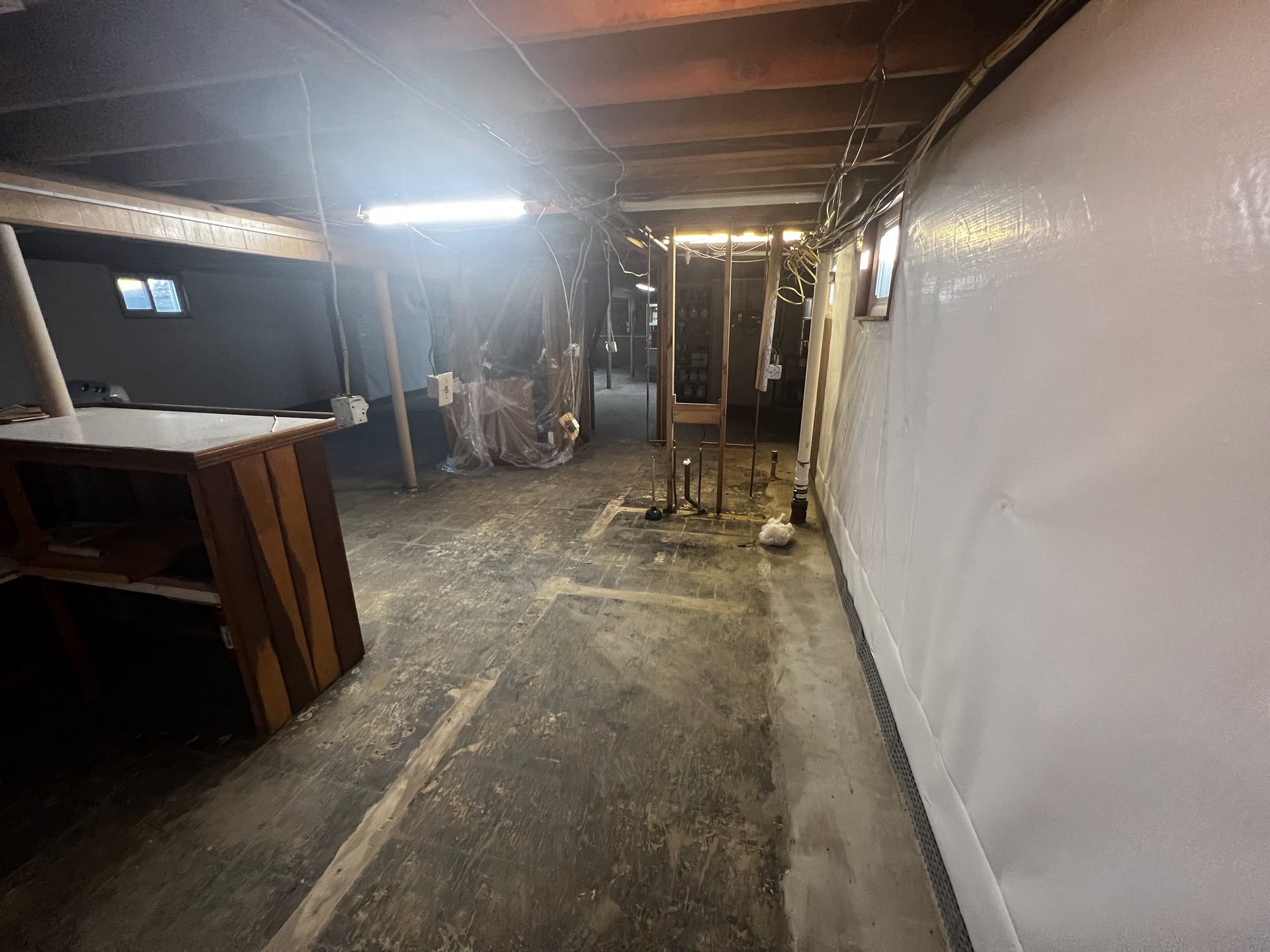
Before — bare slab
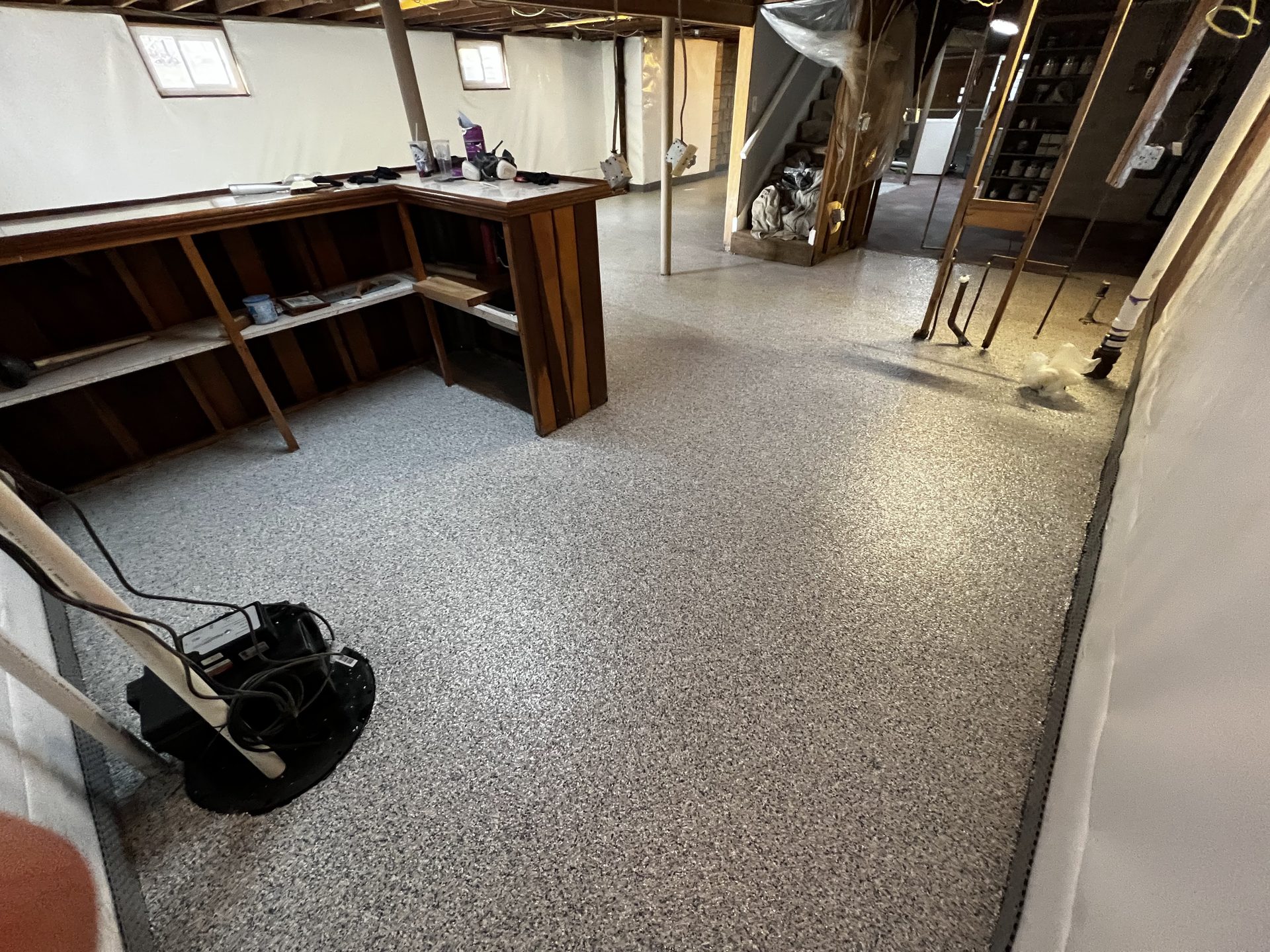
After — coated and flaked
This is the one sequence we have of a single room at every stage, and it is worth more than any finished photograph. Four frames: the slab as we found it, the grinder working across it, the profiled concrete with nothing on it yet, and the finished floor.
A below-grade basement room being brought into use. The starting slab is what most basements actually look like under whatever is currently on them — stained, patchy, with old adhesive and surface contamination, and a troweled skin that looks solid and is not.
The middle two photographs are the point of the whole set. Diamond grinding is not cleaning. It removes the laitance — the weak layer of fine cement paste that troweling brings to the surface — along with old sealer, adhesive and contamination, and it opens a concrete profile with mechanical tooth in it.
The third frame, the profiled slab with nothing on it, is what a coating needs to bond to. Compare it with the first frame. An acid wash would have produced something much closer to the first frame with the stains lightened: salt residue left behind, laitance still in place, and a coating later sitting on a weak layer rather than keyed into sound concrete. That is the mechanism behind nearly every peeling floor.
The last frame is the same room coated. On a below-grade floor the decision that comes before any of this is moisture: a slab that is passing vapor upward will blister a coating from underneath no matter how well it was ground, so the slab gets tested before anything goes down.
Ask any contractor to show you their version of the third photograph. Anyone who grinds has one. It is the single hardest thing to fake and the single best predictor of whether the floor will still be bonded in ten years.
The moisture question is covered in can you coat a basement floor that gets damp, the failure mechanism in why do garage floor coatings peel, and the system on basement floor coating.
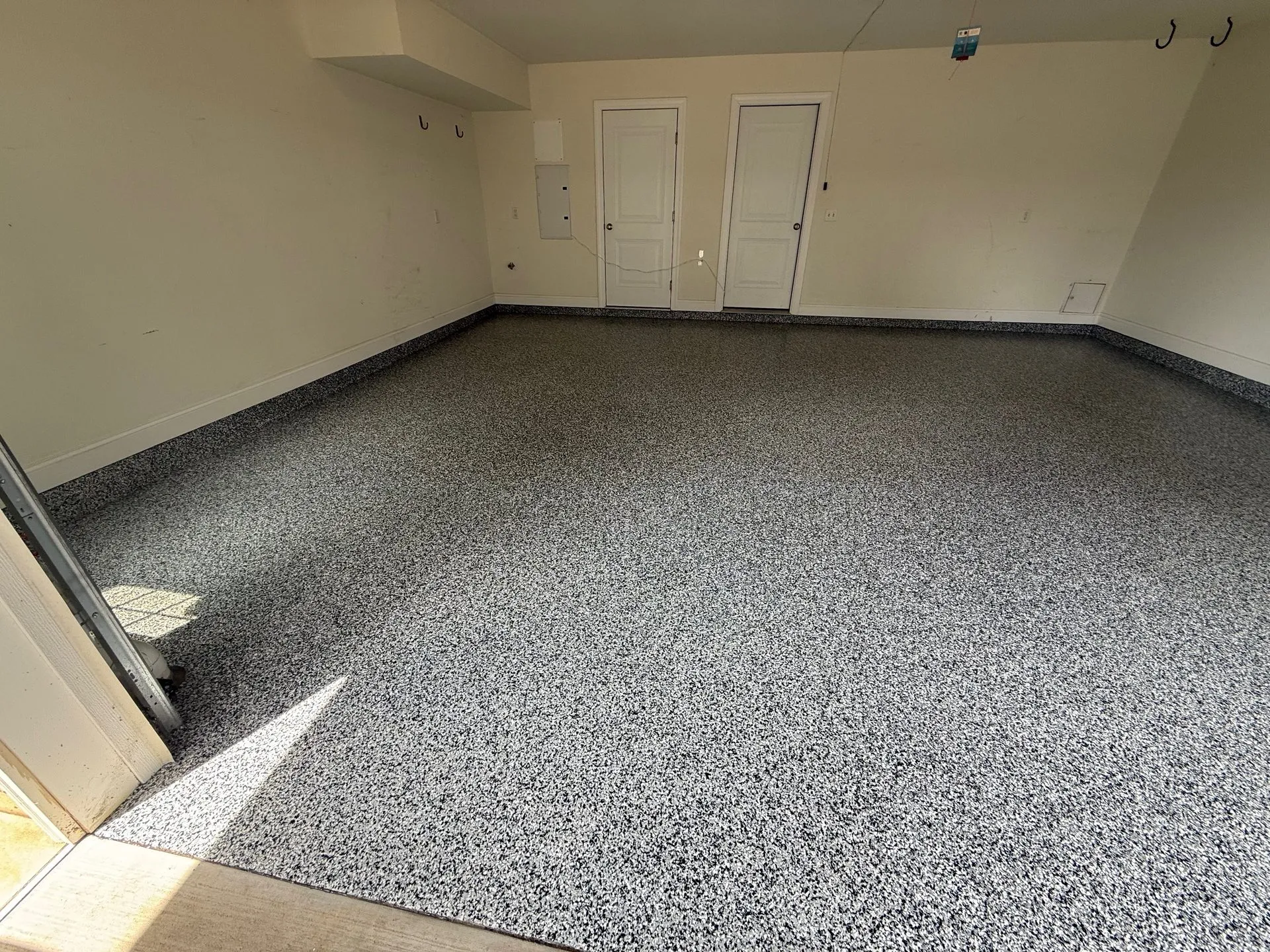
One day on site, vehicles back on the floor in about 24 hours, and a lifetime warranty on the coating.
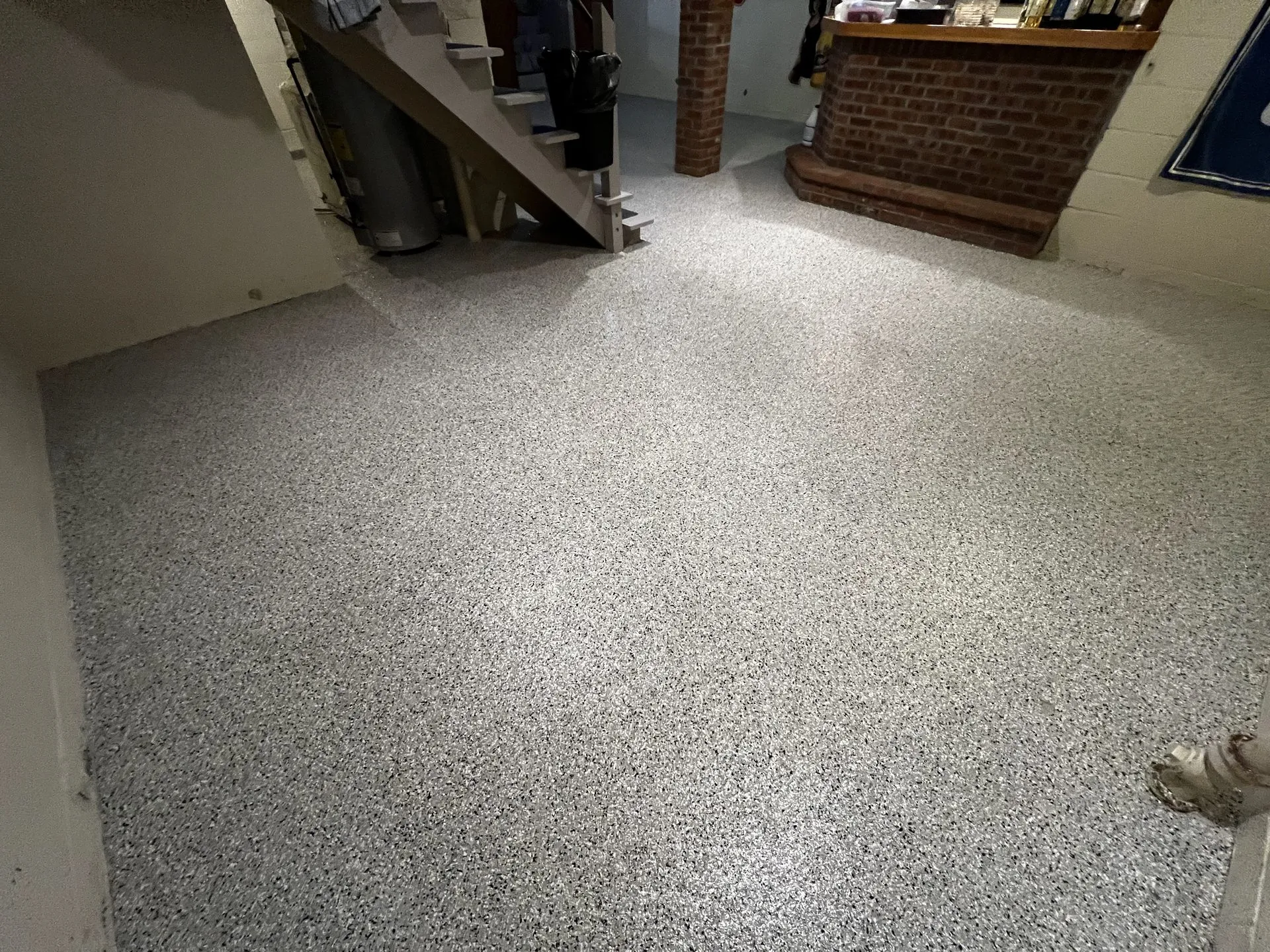
Every step, in order, including why we diamond grind instead of acid etching the slab.
We look at the slab, the joints and the moisture, then give you a firm number at the estimate.
Tell us the room, roughly how big it is and when you want it done. We will measure, look at the slab and give you a price that does not move.
Polyaspartic concrete floor coatings installed in a single day across central Pennsylvania. Every slab diamond ground, never acid etched.
© 2026 Spartic Coatings. All rights reserved.
Serving Lancaster, Chester, Berks, Dauphin, York and Lebanon counties, Pennsylvania.