Garage floor coatings peel because the coating never bonded to the concrete in the first place. The three causes are inadequate surface preparation (acid etching or a light scuff instead of diamond grinding), moisture pushing up through the slab and breaking the bond from underneath, and coating over an existing sealer, paint or failed epoxy. Prevention is mechanical: grind the slab to an open profile, test for moisture before anything goes down, and never coat over a product that is already letting go.

A coating peels for one reason: it was never truly stuck to the concrete. Everything people blame — hot tires, road salt, winter, heavy use — only reveals a bond that was already weak. If the coating is mechanically keyed into an open concrete profile and the slab is dry, hot tires do not lift it. If it is sitting on dust, laitance, a sealer or a damp slab, it will come off, and the first thing to pull it up will be a warm tire on a summer afternoon.
This is the least flattering thing to explain about our own industry, so we will be direct about it.
Failure shows up in a few recognizable patterns, and the pattern tells you the cause.
No, and this is the single biggest cause of failed floors. Acid etching is a chemical wash. It roughens the very top of the surface and it dissolves some of the cement paste, but it also leaves behind salt residue and it does not remove laitance — the weak, fine layer that floats to the top when concrete is finished. Etch, rinse, and you can be left with a surface that looks clean and is still capped with a layer that has almost no strength of its own. The coating bonds to that layer. The layer lets go. The coating comes with it.
Diamond grinding is a mechanical process. Diamond-segmented tooling cuts the top of the slab away, removes laitance and any contamination that has soaked in, and leaves a measurably open profile — visible texture with exposed sand and aggregate that the base coat can flow into and lock around. That is a mechanical key, not a chemical hope. We diamond grind every floor and never acid etch, and it is the reason our process looks slower on paper than a one-crew roll-on job.
Look at the photos of your own floor between grinding and coating. Profiled concrete looks uniformly dull and slightly sandy, with the aggregate starting to show and no shiny or smooth patches. Shiny patches are untouched slab. Ask to see that mid-job photo. Any installer who grinds properly will be glad to show it.
Yes, and it will do it from underneath where you cannot see it coming. Concrete is porous. Water vapor moves up through a slab from the soil below and, if there is no vapor barrier or the barrier was compromised, it keeps moving. When it reaches a coating that is less permeable than the concrete, the vapor collects at the bond line. Pressure builds. The coating blisters and then delaminates in sheets.
The fix is to measure before you coat, not to guess. A calcium chloride test measures the rate of moisture emission from the surface over about 72 hours. A relative humidity probe set into a drilled hole measures the humidity inside the slab itself, which is the better indicator on a slab that has been sealed or that dries unevenly. Either one turns a guess into a number.
If the number is high, the honest answer is not a thicker coating. It is to address the water — grading, gutters, downspout extensions, a sump, or a moisture-mitigating primer specifically rated for the reading you measured. This comes up most often below grade, and we go through it in detail in can you coat a basement floor that gets damp.
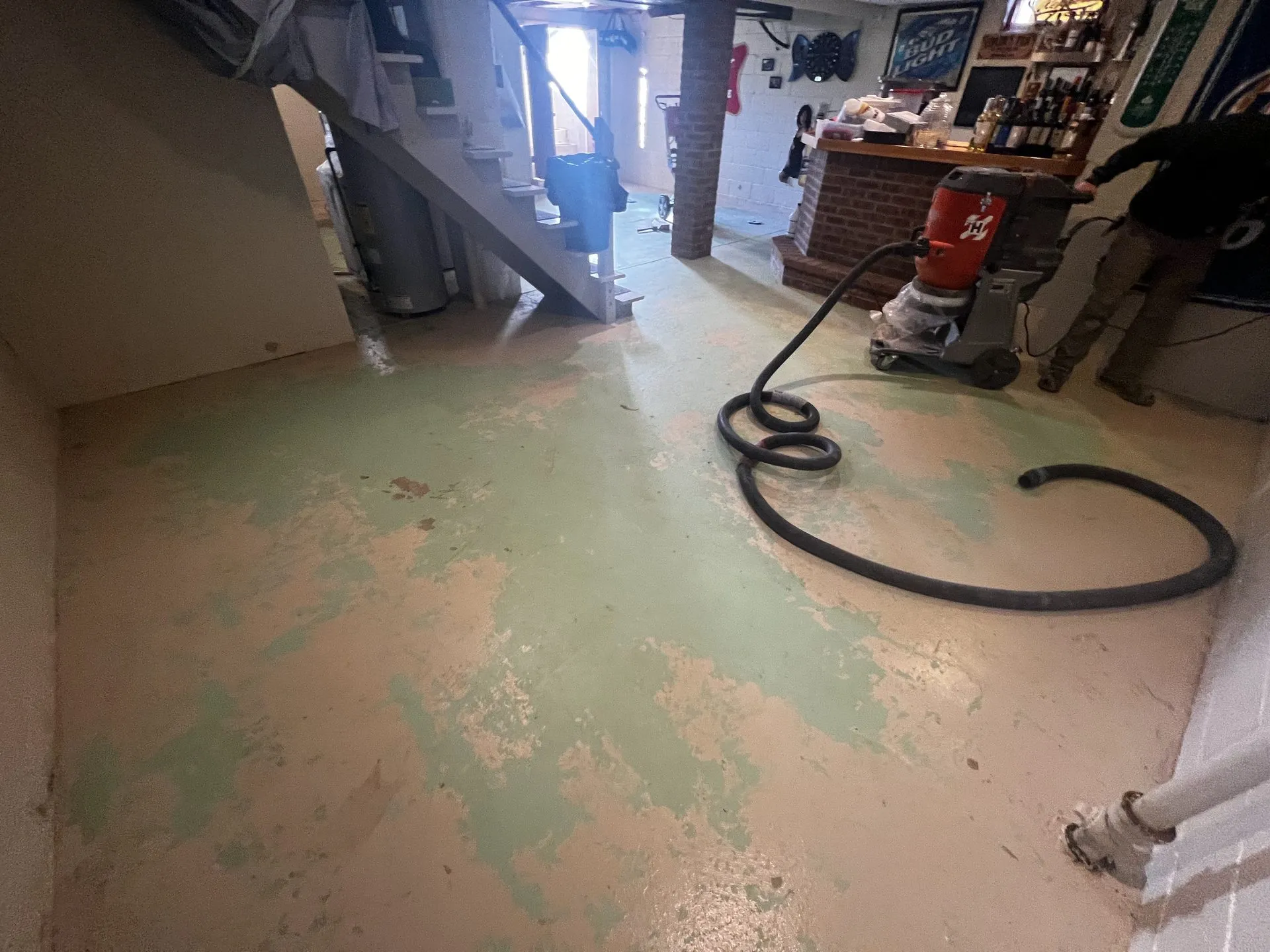
Only if the existing coating is genuinely sound, and most are not. A coating is only as strong as what it sits on, so putting a new product over an old one inherits the old bond. If the old floor has any lifting, chalking, blistering or hollow-sounding areas, a new coat over the top buys you a season and then fails in the same places.
The test is simple and you can do it yourself. Score a small square through the old coating with a utility knife, press strong tape over it, and pull. If the old coating comes up with the tape, it is not bonded. Tap around the floor with a hard object and listen for hollow spots. Any of that means removal — grinding the old product off completely — before new material goes down. That adds time. It does not add optional time.
There is no product that rescues bad prep. Prevention is four decisions, all made before the color goes down: diamond grind to an open profile rather than etch, measure the slab for moisture and act on the reading, remove any existing coating that is not fully bonded, and treat control joints as moving joints. Do those four things and a flake floor with two clear polyaspartic topcoats will take hot tires, jack stands and winter salt without lifting.
If you have a floor that is already peeling, we will look at the failure pattern and tell you what caused it before we quote anything. Contact us and send a couple of photos of the chips, including the back of one.
Three pages that answer the questions this article usually raises.
Diamond grinding, crack and joint repair, base coat, flake broadcast to rejection, two clear polyaspartic topcoats — in one day.
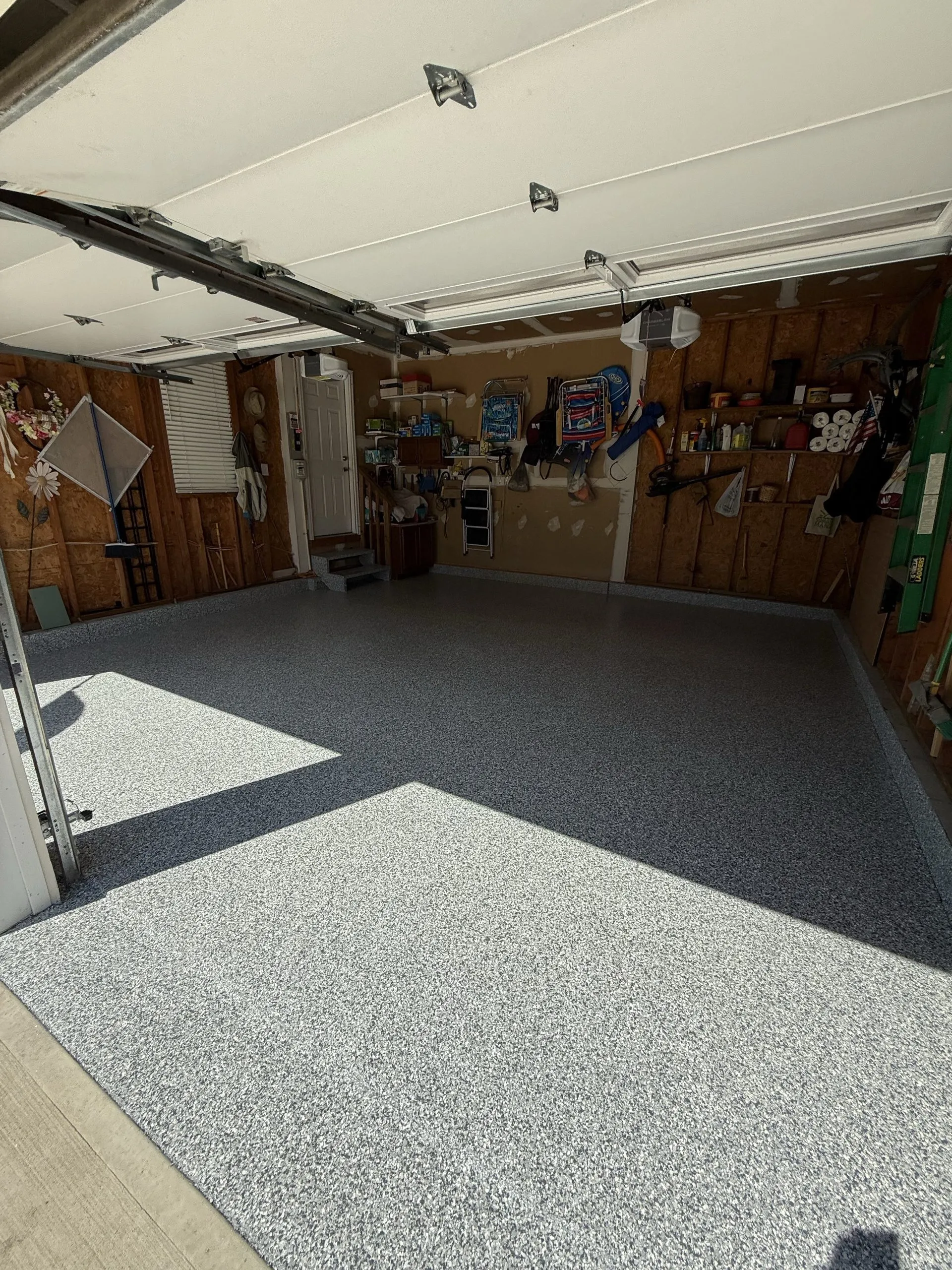
See the blends side by side and how each one hides dust, tire marks and the odd dropped wrench.
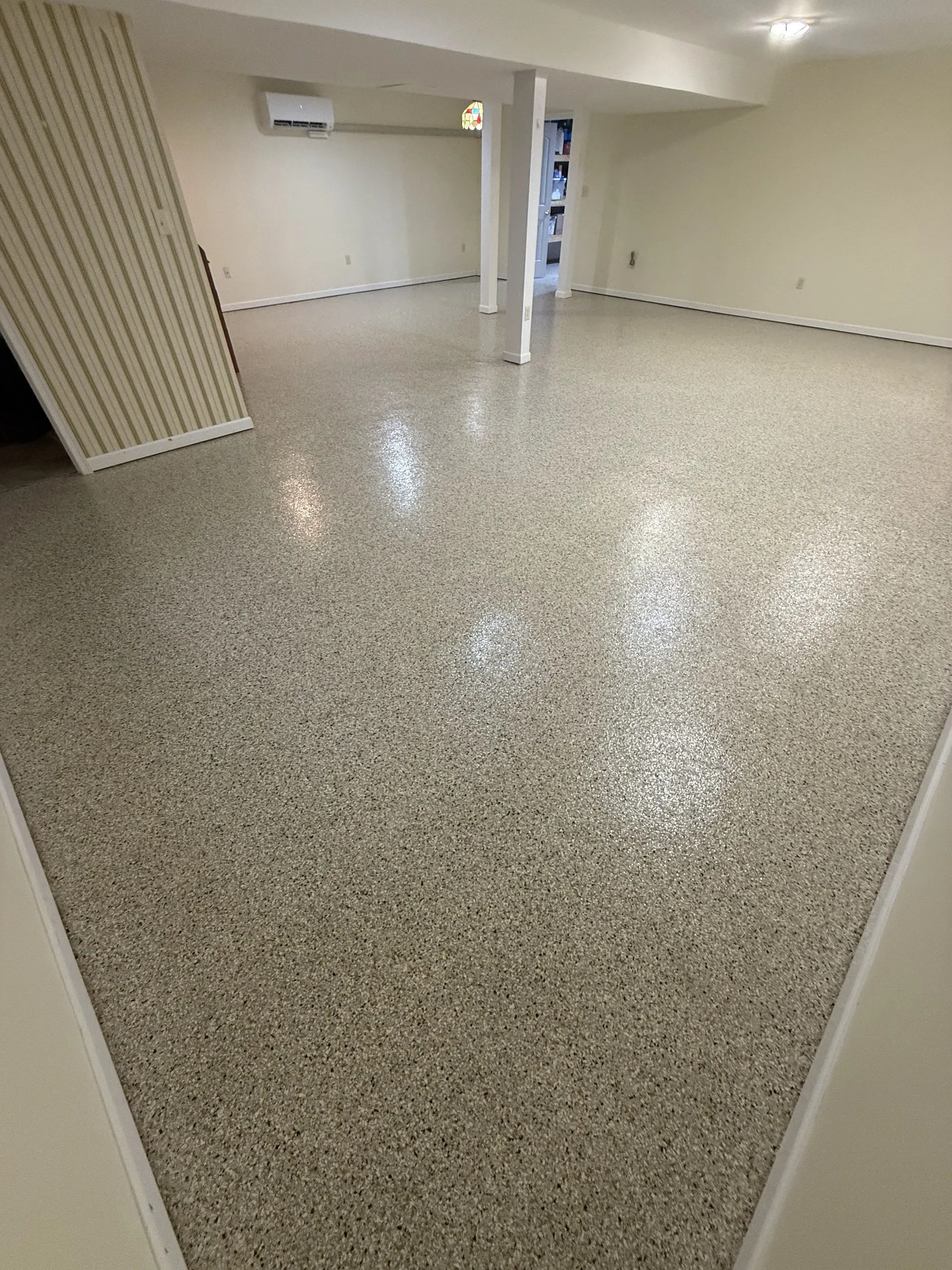
We measure the slab, check moisture and control joints, and give you a firm number at the estimate.
Tell us the room, roughly how big it is and when you want it done. We will measure, look at the slab and give you a price that does not move.
Polyaspartic concrete floor coatings installed in a single day across central Pennsylvania. Every slab diamond ground, never acid etched.
© 2026 Spartic Coatings. All rights reserved.
Serving Lancaster, Chester, Berks, Dauphin, York and Lebanon counties, Pennsylvania.