Plan on 28 days from the pour. That is roughly when a standard slab has reached most of its design strength and released enough of its mix water for a coating to bond and stay bonded. The calendar is a guideline rather than a guarantee, though: a thick slab, a cold season, or a curing compound sprayed on by the concrete crew can leave a 28-day slab still too wet or too sealed to coat, which is why a moisture test on the day is what actually decides it.
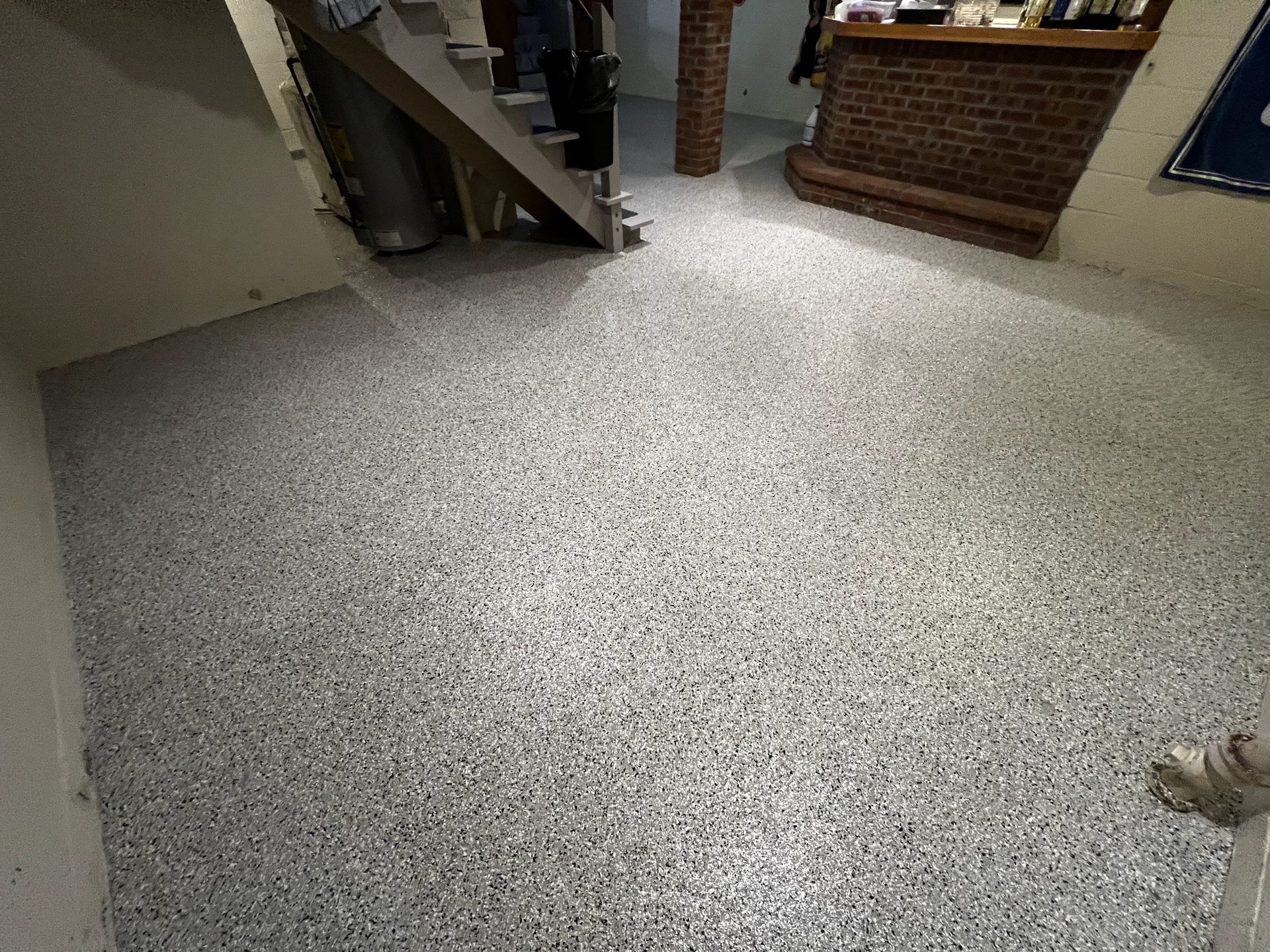
Twenty-eight days. That is the number, and it is the number for a reason worth understanding rather than just obeying. But the date on the pour is not the decision — the slab is. A moisture test the morning of the install is what tells you whether this particular slab, in this particular season, is ready to take a coating.
Concrete does not dry, it cures. The cement and water react chemically, and that reaction is what produces strength. Twenty-eight days is the industry benchmark at which a standard mix has reached roughly its specified compressive strength, and it is also, in practice, about how long it takes for enough of the excess mix water to leave the slab that the remaining vapor movement is low enough for a coating to live over it.
Both halves matter. Strength matters because the coating is bonded into the top few thousandths of the concrete surface. If that surface layer is still weak, the bond is only as good as the crumbly material it is attached to, and the failure comes out of the concrete rather than out of the coating. Moisture matters because a coating is a vapor-resistant film, and any water still trying to leave the slab collects underneath it.
The failure is not subtle and it is not immediate, which is the worst combination. Everything looks correct on day one, and the problem appears weeks or months later.
It is the floor, not the ceiling. Several ordinary things push it out.
Water leaves a slab through the top surface. A four-inch residential garage slab releases moisture at one rate. A six or eight-inch slab, or a slab poured over a vapor barrier with no way for water to leave downward, takes considerably longer. Thicker means longer, and there is no shortcut.
A slab poured in October in Pennsylvania, in cool air with high humidity and short days, dries far more slowly than the same slab poured in June. Cold slows the chemical cure and the humidity slows the evaporation at the same time. A late-autumn pour that hits 28 days in November may well not be ready in the way a late-spring pour would be.
A wetter mix takes longer. So does a slab poured directly onto saturated ground with no vapor barrier, because it is being fed moisture from below faster than it can release it upward. That slab may never reach a low enough reading on its own, and it becomes a moisture-mitigation job rather than a waiting job — the same set of decisions laid out in can you coat a basement floor that gets damp.
Two tests are standard, and both are inexpensive next to redoing a floor.
A calcium chloride test measures how much moisture is coming out of the top of the slab. A sealed dish of anhydrous calcium chloride sits on bare, ground concrete for roughly 72 hours and is weighed before and after. The weight it gained converts to a moisture vapor emission rate in pounds per thousand square feet per 24 hours. Coating manufacturers publish a maximum for their product, and you either meet it or you do not.
A relative humidity probe is drilled into the slab to a set depth and left to equilibrate. It measures the humidity inside the concrete rather than what is coming off the surface, which makes it the better indicator on a thick slab where the top has dried out and the middle has not.
The plastic-sheet test — tape a square of poly down overnight and look for condensation — is a useful five-minute sanity check and nothing more. It will show you an obviously wet slab. It will not tell you whether a marginal slab is inside a manufacturer's tolerance.
This catches people out constantly, and it is a separate problem from moisture. Many concrete crews spray a curing compound or a cure-and-seal over a fresh pour to slow water loss and reduce surface cracking. That is good practice for the concrete and an obstacle for anything you want to bond to it afterward.
A curing compound is a film. A coating applied over it bonds to the film, and the film is not bonded to much. It has to be mechanically removed, which means diamond grinding — not a solvent wipe, not an acid wash. If you know a floor is going to be coated, it is worth telling the concrete contractor before the pour so they can use a compound that is compatible or skip it and wet-cure instead. Nobody asks this and it would save a lot of grinding.
Yes, and more than people expect. A new slab looks perfect, which makes the grind feel unnecessary. It is not. Fresh concrete has laitance on it — a weak layer of fine cement paste and water brought to the surface by troweling. Laitance is soft, it is the top thing a coating would bond to, and it has almost no strength. Coating over it means the coating is attached to a layer that can be scraped with a key.
Diamond grinding removes laitance and any curing compound in one operation, and opens a concrete profile with real mechanical tooth. We diamond grind every floor for exactly this reason and never acid etch, on new concrete or old. The full sequence is on how it works.
Keep it simple and keep it clean. Do not seal it, because you will pay to have the sealer ground off. Do not park on it until the concrete contractor says it is ready. Keep oil, drywall compound, paint and joint filler off it — contaminants that soak into a porous new slab are harder to deal with than surface dirt. And note the pour date somewhere, because in four weeks nobody will remember it exactly.
If you have a new garage, basement or patio slab and want to know when it can be coated, tell us the pour date, the thickness and whether anything was sprayed on it, and we will tell you honestly what the window looks like. Get in touch and we will test the slab rather than guess at it.
Three pages that answer the questions this article usually raises.
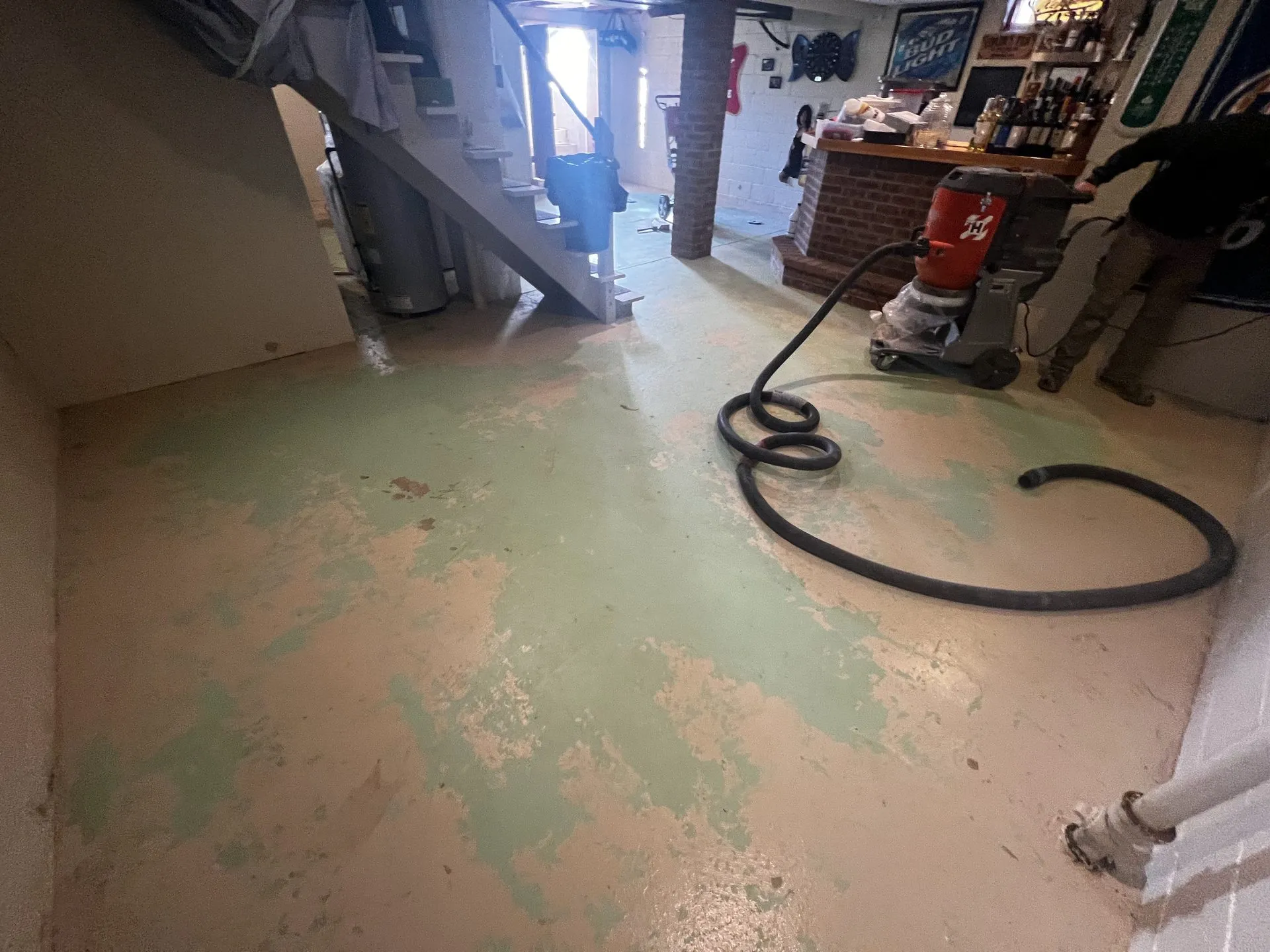
Diamond grinding, crack and joint repair, base coat, flake broadcast to rejection, two clear polyaspartic topcoats — in one day.
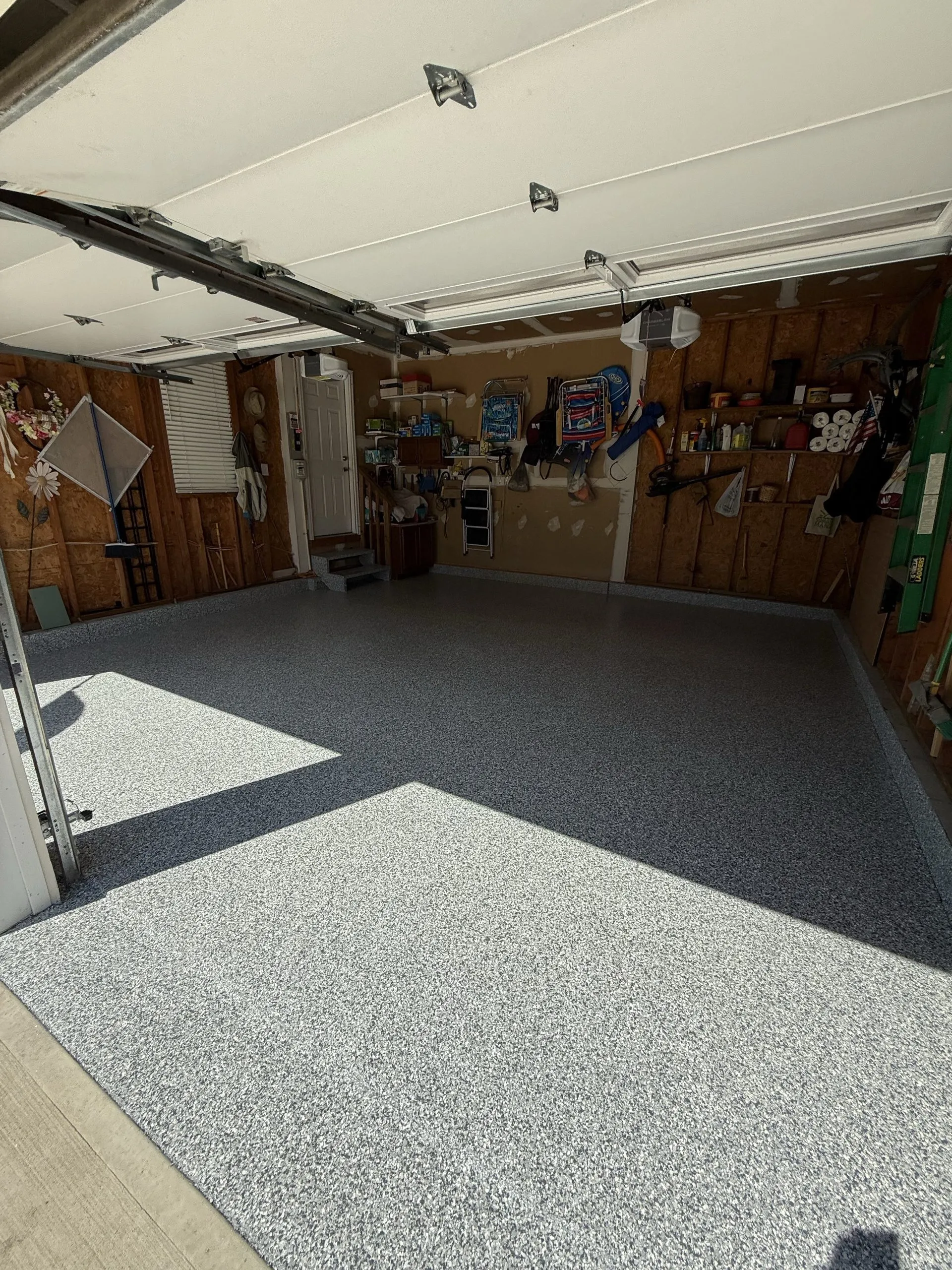
See the blends side by side and how each one hides dust, tire marks and the odd dropped wrench.
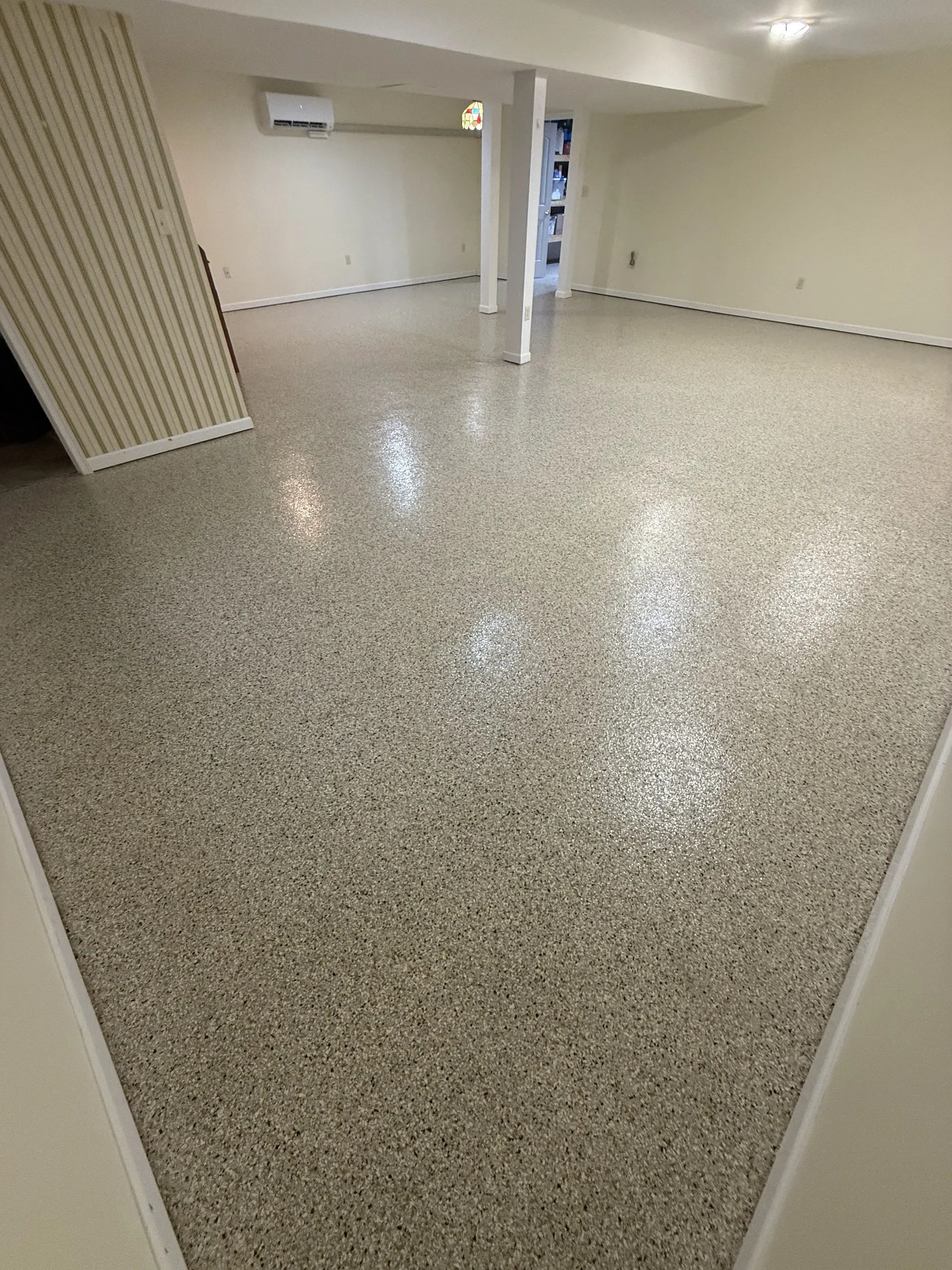
We measure the slab, check moisture and control joints, and give you a firm number at the estimate.
Tell us the room, roughly how big it is and when you want it done. We will measure, look at the slab and give you a price that does not move.

Polyaspartic concrete floor coatings installed in a single day across central Pennsylvania. Every slab diamond ground, never acid etched.
© 2026 Spartic Coatings. All rights reserved.
Serving Lancaster, Chester, Berks, Dauphin, York and Lebanon counties, Pennsylvania.