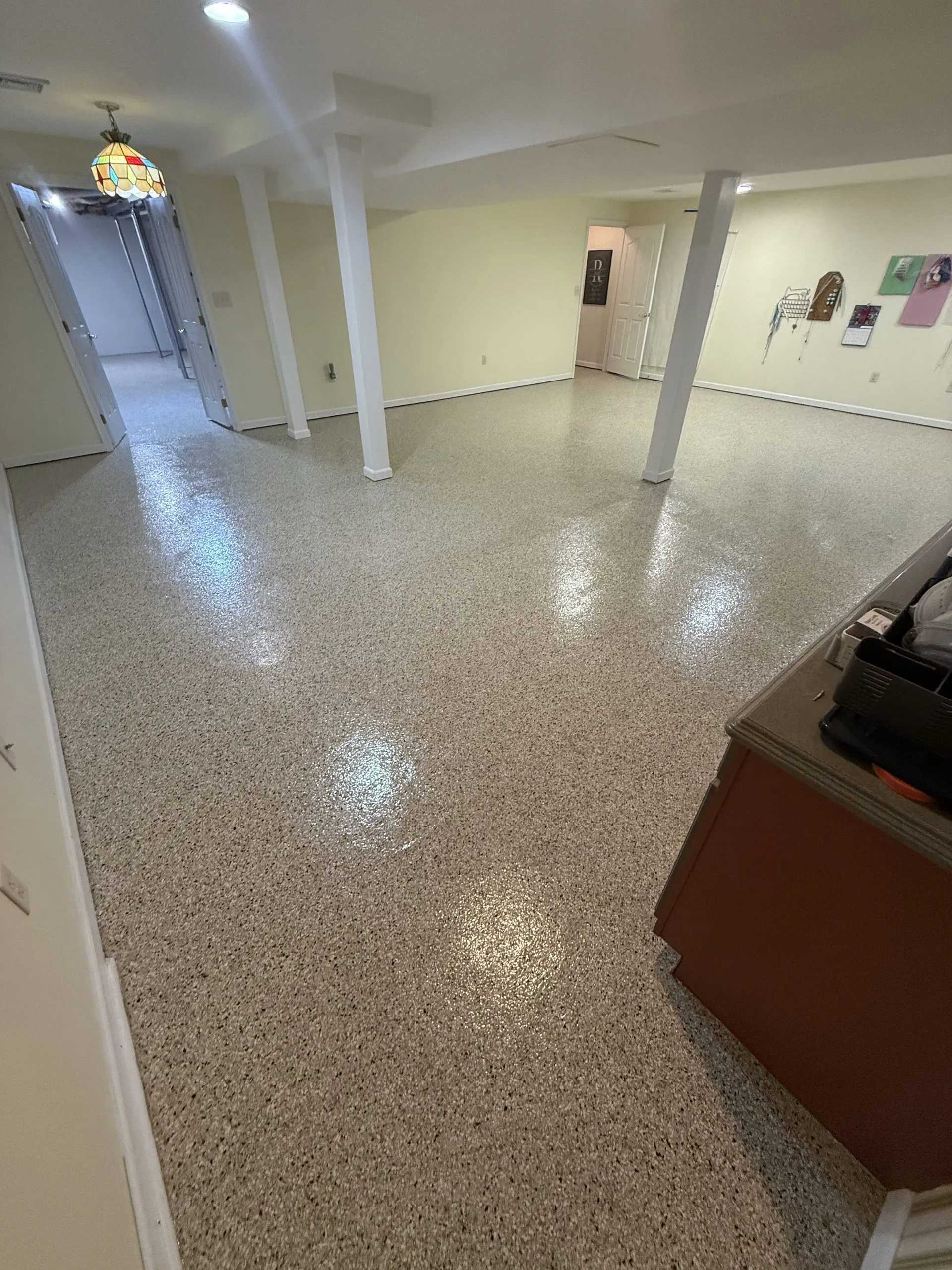
A finished basement living area in a dark charcoal flake blend, run continuously through the open room and out along the corridor. The dark tone works here because the walls are light and the space is lit properly, and a seamless coated floor avoids the joints and seams where a below-grade floor normally fails. This is a finish study of a real floor we photographed, not a record of a specific job.

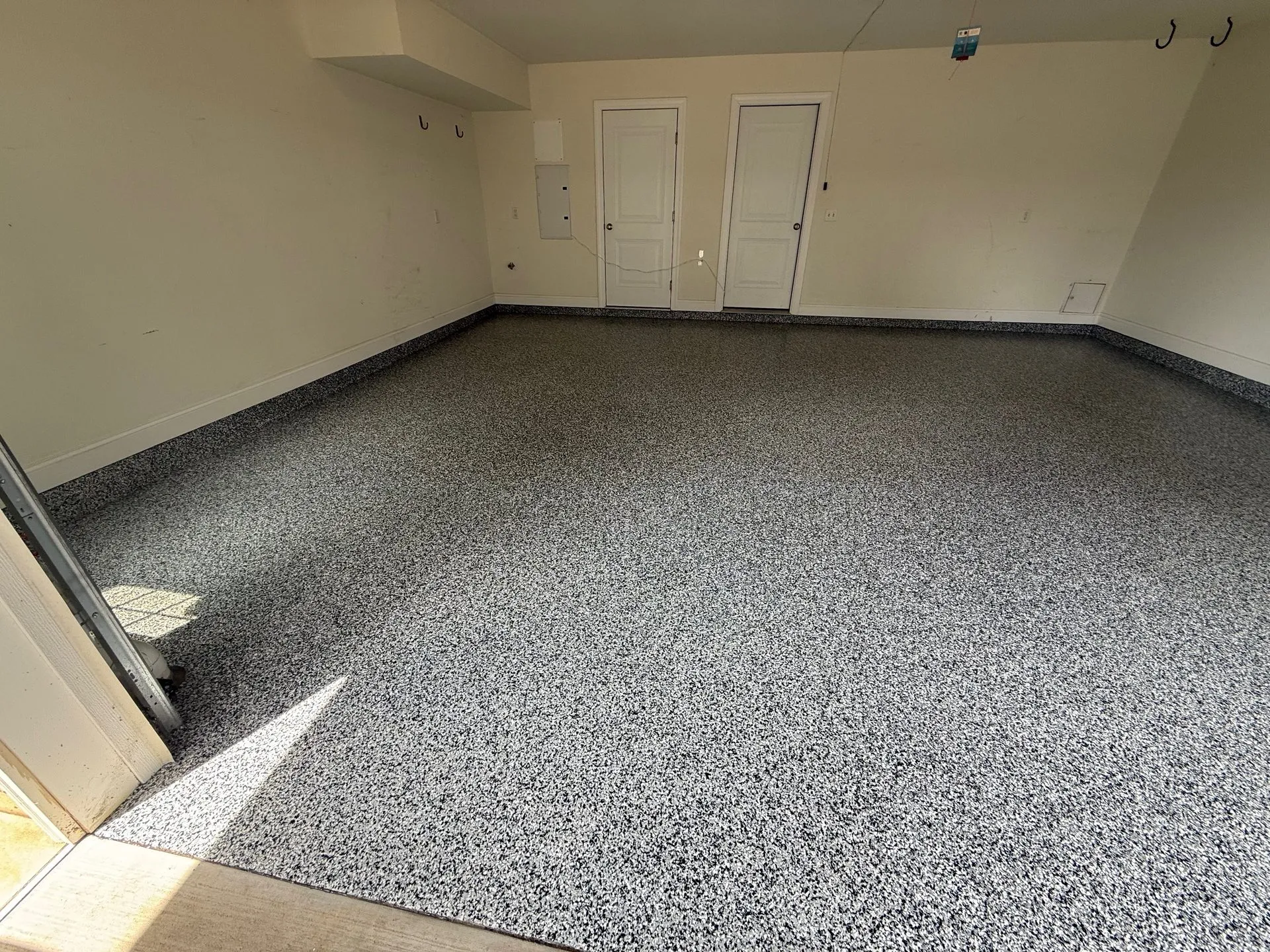
Before — bare slab

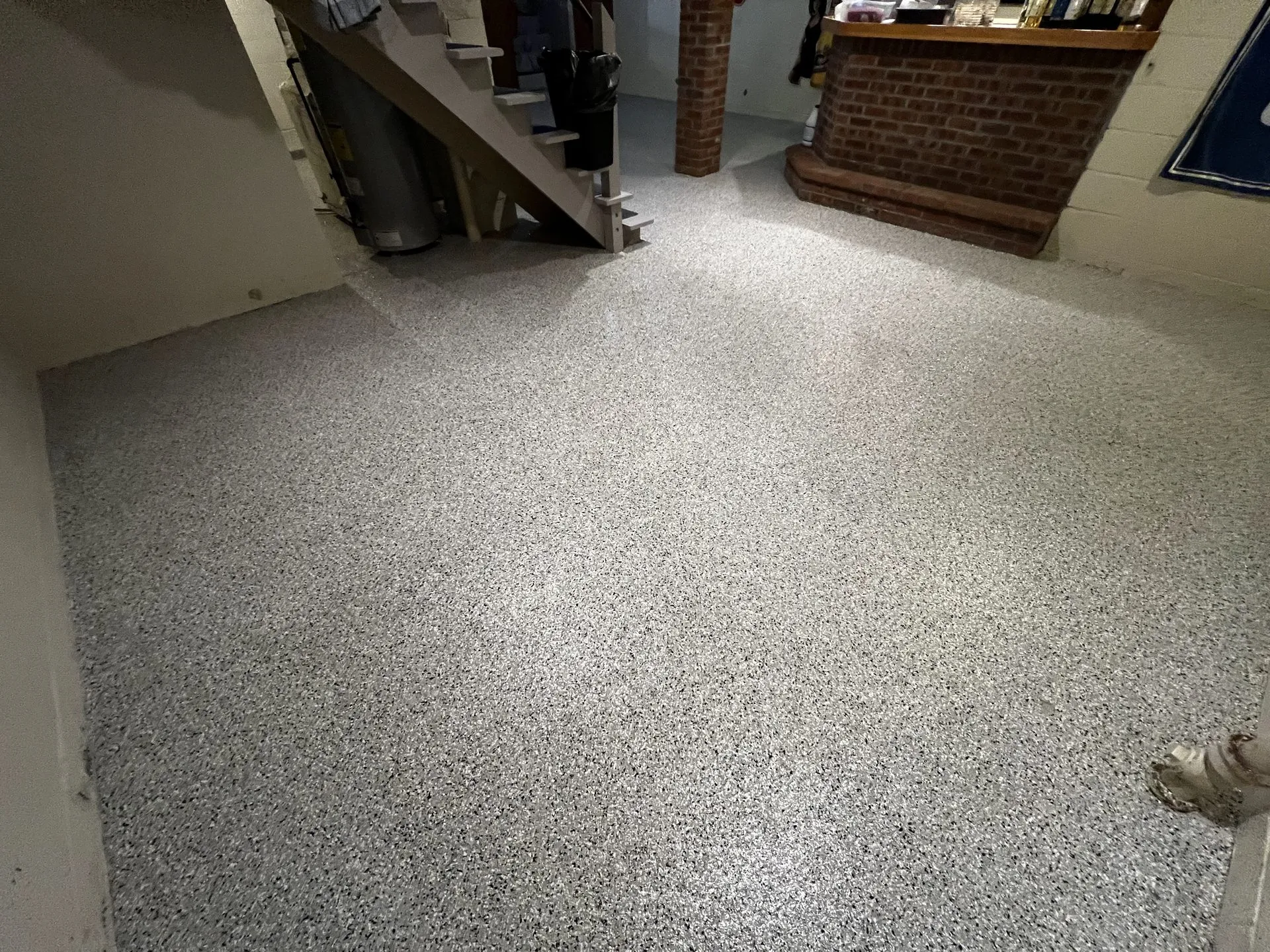
After — coated and flaked
Charcoal is the blend people are nervous about and the one that looks best in a finished basement, provided two conditions hold: light walls and real lighting.
A below-grade living area finished as part of the house rather than as storage, opening into a corridor. The floor runs through both continuously, with no threshold, no transition strip and no change of material at the doorway.
The practical case for a coated floor below grade is that it has no seams. Laminate, vinyl plank, engineered wood and carpet all sit on top of the slab and all give moisture somewhere to collect and something organic to feed. A coating is bonded to the concrete itself. If the slab is dry, there is nothing under the floor for water to get into.
The aesthetic case is the continuity. Running one finish from the open room down the corridor makes a basement read as a floor of the house rather than a series of separate below-grade rooms.
The honest trade-off with charcoal is that it shows light dust. It looks excellent swept and slightly dusty in between. In a living space that gets vacuumed anyway this matters far less than it would in a garage.
Look at the corridor and the doorways. The finish carries through the transitions cleanly, which means the perimeter and the tight areas were hand ground to the same profile as the open floor. Edges and doorways are where a rushed job shows first.
Sort out the water before you think about the color. Air humidity in a basement is not an obstacle. Measurable vapor coming up through the slab may need a moisture-mitigating primer. Active water pushing up under pressure has to be fixed before any floor goes down, coated or otherwise. Get the slab tested and get the reading written down.
Then, if you want dark, add light. The full picture is on basement floor coating and the moisture decision tree is in can you coat a basement floor that gets damp.
One day on site, vehicles back on the floor in about 24 hours, and a lifetime warranty on the coating.
Every step, in order, including why we diamond grind instead of acid etching the slab.
We look at the slab, the joints and the moisture, then give you a firm number at the estimate.
Tell us the room, roughly how big it is and when you want it done. We will measure, look at the slab and give you a price that does not move.
Polyaspartic concrete floor coatings installed in a single day across central Pennsylvania. Every slab diamond ground, never acid etched.
© 2026 Spartic Coatings. All rights reserved.
Serving Lancaster, Chester, Berks, Dauphin, York and Lebanon counties, Pennsylvania.